
I have always loved music, what it does for me, how it shapes a community, and how it elevates our spirits and provides energy to go forward in life. I’ve spent a lifetime singing hymns in church, chanting parts of the liturgy, playing some guitar, and leading children in Vacation Bible School songs.
In retirement, I have joined a Barbershop Chorus and have found, in its ability to unite people of different convictions, that it is “ministry adjacent.” But I don’t have a lot of formal musical training.
Traveling with a trained choir and some professional musicians is a new experience for me. I can understand some of the choral chatter the way I can understand conversation in a Paris cafe with my high school French. Not so much!
I have appreciated learning a great deal by simply listening to conversations this week and, when I didn’t understand things, having choir members patiently shed more light. Here’s something that amazed me.
Did you know that there is standard pitch (A-440), which is the usual vibration for the note “A,” around which all other notes find their place? It’s how orchestras tune up. My electronic tuner is set to A440 so my guitar strings don’t sound so much like Credence Clearwater. If you change that A440 to, say, A450, it makes a big difference.
Well, that is what your brilliant choir and choirmaster have had to adapt to when we came to Salisbury. The organ is tuned to something like A450. It brightens the sound up. But it’s not without its costs.
This means the highest notes are that much higher (and harder) to sing, especially if you are singing in that lofty range for a long time. (Think of the fourth movement of Beethoven’s Ninth and how the sopranos have to screech out stratospheric notes for lots of measures. And now think of having to do this a half or whole step higher than you expected).
I already have appreciated this choir for many reasons: its friendliness and care for each other; the way it is game for anything; the way it shows up everyday “ready to play;” focussed, determined, and resilient.
But overhearing this piece of musical intelligence about A440 made me realize again how talented and committed these vocalists are, how high their standards of performance, and how they can be graceful about things, when it is hard.
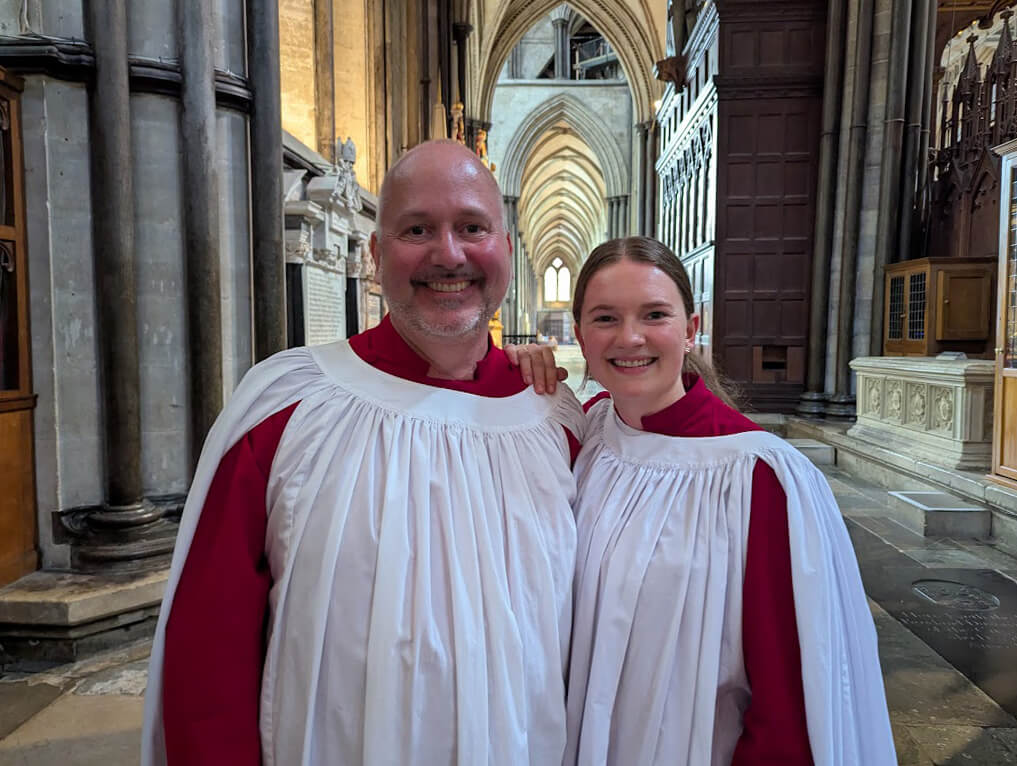
St. James, Apostle and Martyr
Today, at a magnificent choral Eucharist to mark the Feast of St. James, our choir sang a Howell Mass setting to perfection, lifting an already colorful liturgy, marked by rich red vestments and frontal (for James’ martyrdom) into a regal, spiritual realm. The motet the choir sang during Communion (Batten’s When the Lord turned again the fortunes of Zion, then were we like them that dreamed) was, well, dreamy. I know this is not a real musical term, but I am out of my depth here!
The music enhanced a liturgy, which included a superior sermon on the martyrdom of James, the lore that grew up around him, and how he bravely embodied the solemn prediction of Jesus: “the cup that I drink you shall also drink.”
FYI, I happened to be sitting next to a woman named Annabella who I learned is the wife of Fr. Tim, the preacher. She was eager for me to meet him. When I did, he expressed how fine this choir is. The Cathedral Dean, Fr. Papadopulos, who has been introducing the St. Paul’s Choir all week, chimed in, “This choir is exceptionally good!”
Portsmouth
I need to go to bed soon because I’m getting up at 4 a.m to go with my family to Stonehenge. So my review of today’s other events, which were totally wonderful, will be brief.
This morning, about 15 members of our group went to the Portsmouth Shipyards to tour ships and see this working dock. Various boats were toured, but my daughter Jen toured the HMS Warrier and was awed by the experience of walking its decks. Others may supply some pictures and accounts later.

Old Sarum

I went with my younger daughter’s family on a Number Seven bus to Old Sarum, the original Salisbury. It is atmospheric, set on a high place, with circular earthworks around it and a large daunting moat.

Old Sarum was the site of a settlement from Neolithic times and was successively built on, enlarged, destroyed, and rebuilt by the Celtics, Saxons, Romans, Vikings, and the French Normans who came to rule it in the 11th Century.

The outlines of the fortress, the palace, and the first Salisbury Cathedral are clearly visible. We spent a happy two hours soaking up the sun and walking through these evocative ruins.


Back to Bemerton
In the afternoon, I again took the walk across the meadow to Bemerton, the parish of poet and priest George Herbert. I was keeping an appointment with Lesley Burton who had invited me over to meet her colleague Peter Webster.
As I walked up to the St. John’s Center (a church built to honor George Herbert but now serving as a community center with many purposes), Leslie was waiting for me at the Lychgate. She walked me through the door, introduced me to Peter, and then brought out tea and cookies.

Peter showed me a whole wall of books by and about George Herbert, told me many things I hadn’t realized, and was genial in every way. After 50 minutes, he excused himself because a plumber was coming to his house. Lesley offered to drive me back to the Cathedral because, if I walked, I would have had to leave instantly.
This allowed me to stay on for another half hour. I learned that Leslie has lived 40 years in Bemerton, and that she once was employed at Salisbury Cathedral as the “Steward of all the stewards,” the guides, greeters, communion stewards, and volunteers (of which there are over 400.) This suggests an enormous commitment and love for the Cathedral from the surrounding community.
We walked over to Leslie’s house, and she dropped me at the High St. Gate to the Close, with a promise to come to Saturday Evensong (if she possibly could) to hear our fine choir.
I love these chance meetings with people. They are, for me, one of the highlights of travel, creating a sense of community which transcends time and space. Beyond the beauty of stone, marble, paint, and glass, it is the sound of people’s voices, the light in their eyes, and the stories of their lives which fill me with gratitude. God’s workmanship, you might say.
Good night and God’s blessing upon all whom you love and belong to.
Greg+
About the Author

The Rev. Gregory Sammons, Diocese of Ohio
The Rev. Gregory Sammons is a retired priest of the Diocese of Ohio, now living in Dayton. The father of Liz Rodems (a second soprano in the St. Paul’s Senior Choir) Gregory is traveling to the UK with the Senior Choir and will serve as the trip blogger.
Follow along with his daily writings through the Stories from Salisbury blog.