
This morning, strolling with my grandsons through the garden adjacent to the hotel breakfast room, I realized I had come to the hardest part of a trip. It’s when I begin to count “the last time for…” and know it is about time to leave.

My room has a cluttered, “lived in” look, my carefully hung shirts are now slung hurriedly across hangers, the receipts from countless meals sitting like fallen leaves on my dresser, my shoes in imaginative corners of the room where I kicked them off.
We’ve lived at the White Hart in Salisbury for nearly a week. It feels like home. I can find my way back from the train station without GPS. I keep passing familiar places where we have made memories, like The Bishop’s Mill (where I can almost recite the menu.) No sooner do we feel “at home” in our lives, and then we are called to move on.
My suitcase, unused for a week, will soon be stuffed with clothes which badly need washing. But I will also pack memories so precious that they will be with me for the rest of my life. I am ready to go home, but it’s still hard to let go of this blessed adventure.
I am deeply grateful that I was asked to chronicle this trip. My prayer has been that my memories and experiences, though not identical to yours, may have resonated with you in some way. I hope that my words have encouraged you, in some small way, to treasure what has happened to you as a result of being on this journey (literally or vicariously).
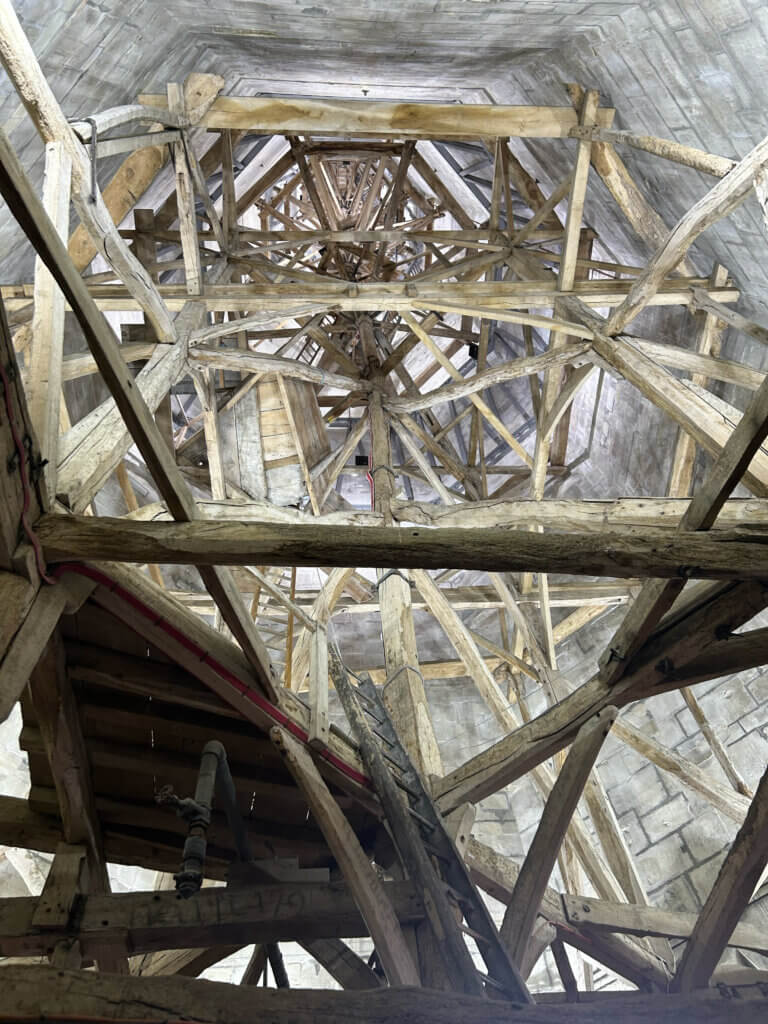
My daughter Jen and I took the train to London yesterday to see the smash musical Hadestown, a show that connected deeply with both the grief and the necessity of living with an open heart, as a pilgrim upon earth. My daughter Liz and her family toured the Cathedral tower and reported that it was breathtaking, enhanced by a magnificent tour guide, “one of the best we’ve had!”

Several choir members, including my son-in-law Rick, walked to Lower Bemerton to see George Herbert’s church, St. Andrew’s, and all of them agreed that the walk itself, along with the destination, was a highlight. It embodies everything that comes to mind when you think of a walk in the English countryside.

Others among us took the journey to Stonehenge on Friday or Saturday, some near sunrise and some at sunset, and reported that it was well worth the journey. Although, those of us who went at sunrise almost never returned—but that’s a story for another time.
There was something about the grandeur of Stonehenge, situated in an open space on high, windy ground, that evokes the awe the ancients must have felt. Without the benefit of cranes or other helpful machinery, they hauled and hoisted massive stones, some from as far away as Wales, and lined them up with the cycles of the sun and moon.
Did they seek to control the seasons through sacrificial offerings, placating the gods so that seedtime and harvest would return? Or, in lining up the stones to trace the heavenly bodies, were they simply honoring “what is” and trying to align their lives with an awesome mystery they observed but couldn’t control? We have no idea.

But we recognize the instinct. It’s much like the instinct which led people to build the great cathedrals. What can we do with our feelings of awe, fear, and gratitude, except to express it “upward” to the heavens? How can we say “thank you” for the sweet gifts of life if our hands and bodies don’t join our voices in prayer and song?
Saturday Evensong: a Dancing Priest!
Every singing occasion for this choir has moved me. I have struggled to put intelligent words around the intangibles of harmony, rhythm, text, and style. Last night, however, produced a reaction that I imagine most choir members had never seen before.
Nell Davidson reports: “The priest tonight was so excited by the music—she was incredibly happy, gave Kevin a hug, and went skipping joyfully into the vesting room.” This was not a mirage. Many others confirmed this rare sighting. Hugging and skipping—not terms one usually associates with a staid Cathedral Evensong or composed Anglican clergy. But I think it is a measure of the unique gifts of this choral director, choir, and organist. After proving at earlier services their mastery of more traditional Cathedral fare, last night the Choir broke out with an American anthem, Alleuluya, Salvation, Glory, and Honor by Wilfred J. Emery. Though written in 1949, it breathes the air of earlier American music which reminds us of big skies and wide-open spaces.

Holy Trinity, Bat Man!

The Holy Eucharist this morning was the beginning of a season-long celebration of the 1700th anniversary of the Council of Nicaea (325 AD), which settled (for a while) a simmering theological civil war. On one side, there were Arians, those who held that Jesus Christ is subordinate to God and thus is not ontologically God (i.e., God-from-the-beginning). The other side was Athanasian, who taught the co-equality of the first two persons of the Holy Trinity, thus preserving the doctrine of the Unity and Oneness of God.
You might think that a sermon on this subject would be a sleepy experience. Not for me! The preacher was clear, concise, humorous, and accurate in his description about what was at stake in this theological showdown. And he invited the congregation to continue on this journey through the year as the Cathedral clergy and guest preachers illuminated every phrase of the Creed we say each Sunday. Bravo, I say!
We need more of this in the church. We can’t know who we are until we understand where we’ve been. I imagine not one in a hundred of us think seriously about the meaning and point of the phrases in the Creed we say weekly. It would change our life if we did.
My eyes misted up as I saw our fine choir come up the long aisle, behind the Verger, all the way to the West End, to process down for the opening hymn. Todd Wilson, as organist, covered this long walk on the organ, making it truly grand and filled with anticipation.
We sat in the Nave, so the choir was far away from us. Instead of seeing faces, and hearing “parts” come in and out (which is so evident during Evensong), there was instead an ethereal sense of being serenaded by angels, as the music swept down upon us from the faraway quire.
Once again, we were treated to the Langlais Solemn Mass and a delicious Communion anthem O sacrum convivium by Near, both sung with authority and soulfulness. The clergy of Salisbury, their guest preachers, and their friendly-but-firm vergers and ushers continue to impress us. They create a welcoming space and help maintain the boundaries so the focus is on the worship.
The Parting Glass
I enjoyed a long Sunday afternoon stroll around the Cathedral and saw, with the help of a guide, the stick which they put through a hole in the south arm of the crossing to test the water level. Amazingly, Salisbury only has a four foot foundation under it, and water seeps through the gravel of this place that was once marsh land.
I lingered in the cloister and marveled at the African fabric art, braided around the ancient pillars, as a symbol of the difficult history between Europe and Africa. And then I went in and looked at the breath-taking Chapter House, where an original of the Magna Carta is stored.

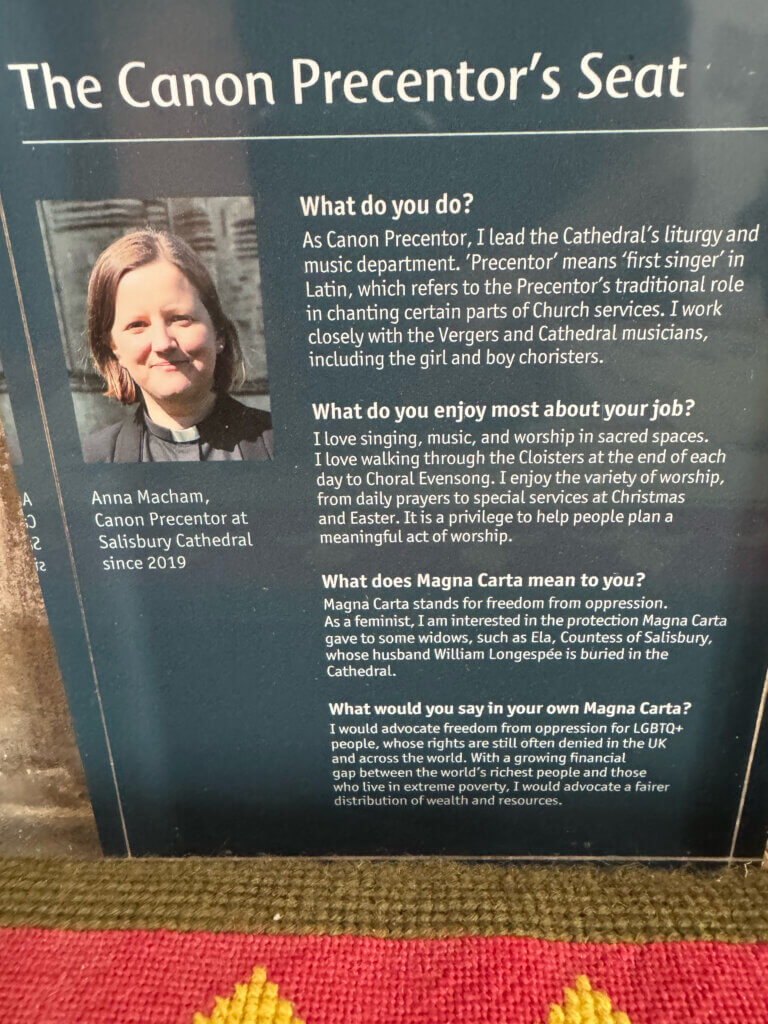
I was moved deeply by the quotations from the chapter clergy, Dean Nicholas Papadopulos and Precentor Anna Macham (both of whom we got to know this week as they were at almost all the services). Both of them speak eloquently of the relevance of the Magna Carta.

Then it was time for the last Evensong. Like almost all of the services (including over 200 gathered at the Morning Eucharist), the Evensongs have been exceptionally well-attended. I am sure there were at least 70 or 80 there, not including the choir! It was poignant to sit in that space, filled not only with so much history, but so many of our memories of the past week, for the very last time.
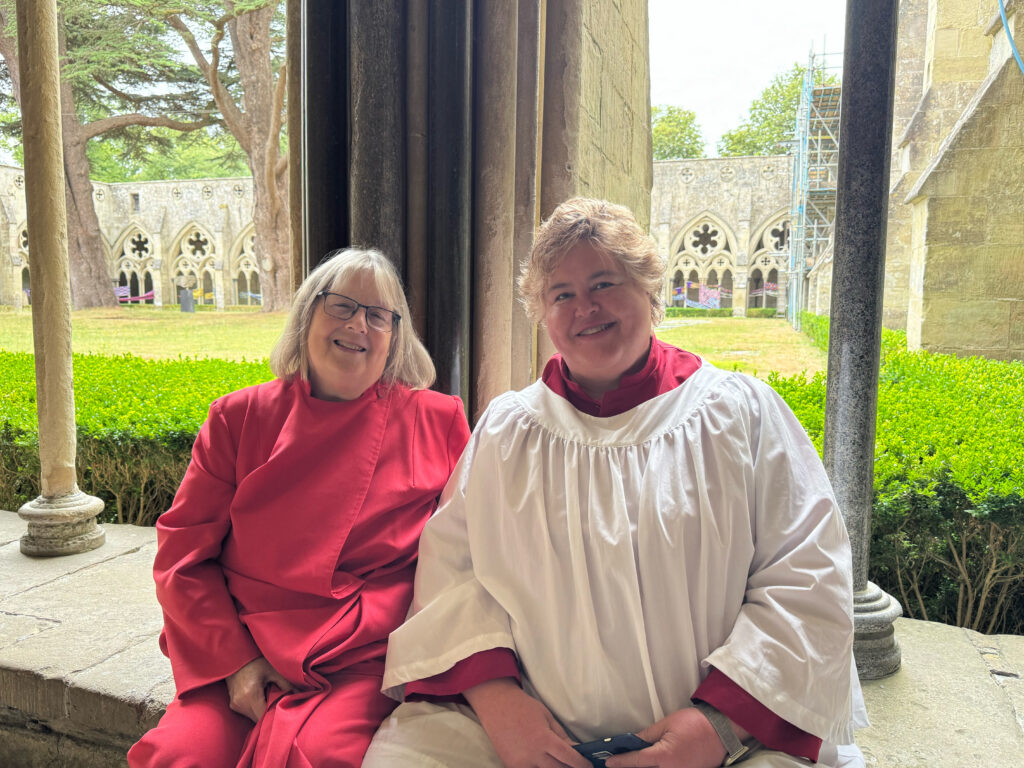
We heard a stirring sermon by the Rev. Ross Meilkle, missioner for young people, about the Gospel’s demand for the inclusion of all God’s people, and especially the LBGTQ+ community. Fr. Meilkle explicitly implored the English House of Bishops to come out strongly in defense of the trans community who are being scapegoated by the rhetoric and actions of hostile politicians.
Most of the music we heard tonight we had heard before, but it was even more thrilling in this golden last moment. A standout was the anthem, sung to a John Donne text:
Hear us, O hear us, Lord; to thee
A sinner is more music, when he prays,
than spheres, or angels’ praises be
…we know not what to say.
This brought a lump to my throat. It seemed like a benediction on this whole journey which was now in its midnight hour. The beauty, the friendship, the worship and music, the chance encounters and the moments of pure magic, the bowing down empty, and the rising up full. How can we put into words what this has meant to us?
“We know not what to say.” Perhaps these words from John Donne’s godson, George Herbert, might suffice:
Seven whole days, not one in seven, I will praise Thee
and the cream of all my heart I will raise Thee.
In a moment, we will gather for a last dinner before dispersing. And we will certainly raise a parting glass to one another. I raise one to each of you, my beloved family, here and at home; to my new St. Paul Senior Choir friends; and to each of you at home, who took this journey with us in your hearts and imaginations.
We have all felt buoyed by your loving thoughts and prayers, and we can’t wait to see you when we return home. Until then, be well and…
Farewell,
Greg+
About the Author

The Rev. Gregory Sammons, Diocese of Ohio
The Rev. Gregory Sammons is a retired priest of the Diocese of Ohio, now living in Dayton. The father of Liz Rodems (a second soprano in the St. Paul’s Senior Choir) Gregory is traveling to the UK with the Senior Choir and will serve as the trip blogger.
Follow along with his daily writings through the Stories from Salisbury blog.